How to Switch Careers in 2027 Without Starting from Zero
How to Switch Careers in 2027 Without Starting from Zero
Your past is not a cost you pay again. It is the foundation you build on.
This guide shows how to find the skills you already have, close one gap at a time and tell a clear story, and how requirehire.com helps you build a skill-scored profile that supports your new direction.
A note before you read
This guide is published by RequireHire's content team for working professionals, recent graduates and anyone returning to work who is considering a change of direction. Last updated November 2026. Every career move depends on your field, your circumstances and the market. It focuses on what you can control: your skills, your evidence and your story. To be clear about scope, requirehire.com is India's interview-first hiring platform with structured AI interviews, skill scores, mock interviews, aptitude practice and a resume check.
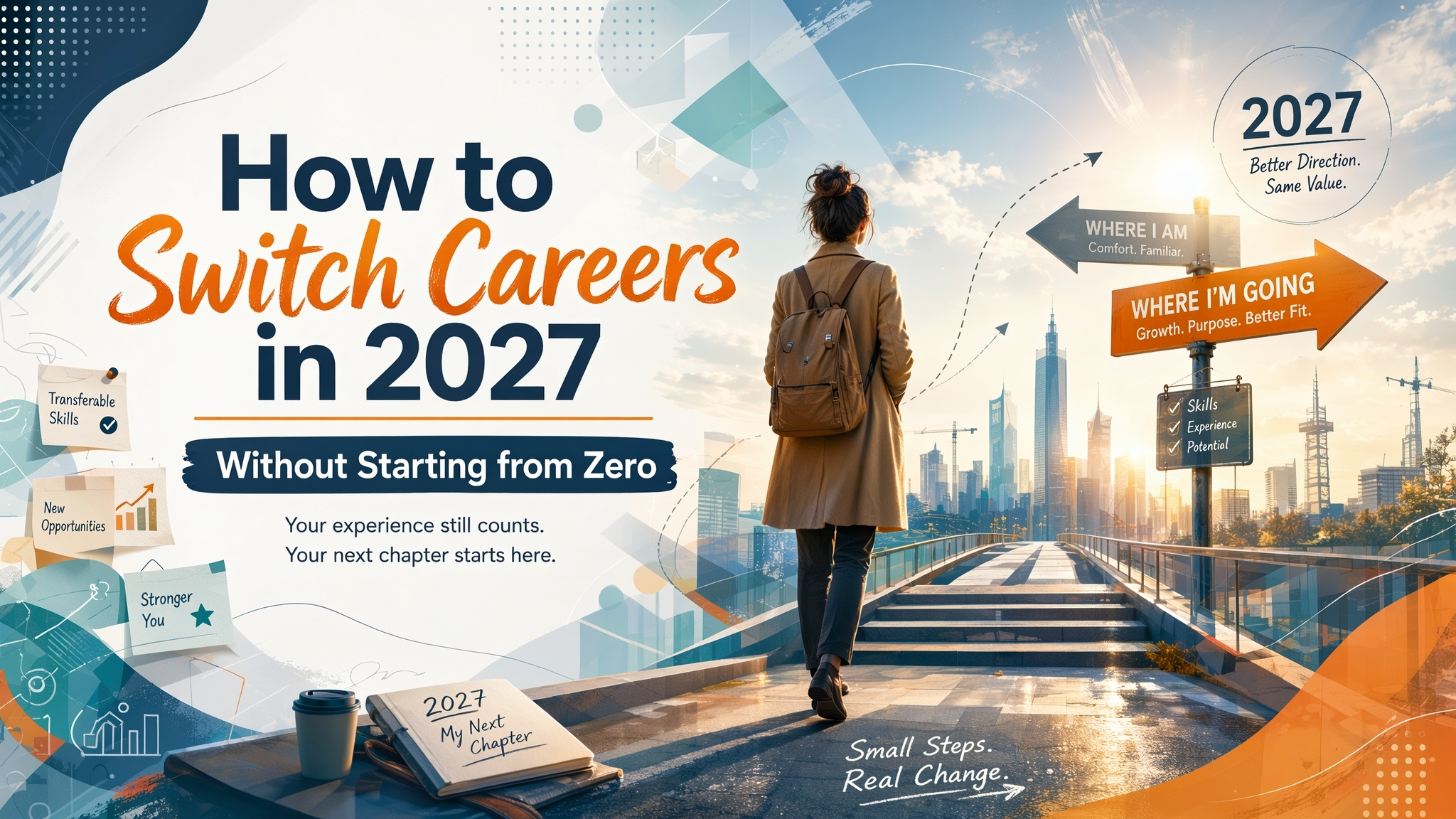
Why Does Changing Careers Feel Like Starting Over?
Ask anyone who has thought about changing careers what worries them most, and the answer is often the same: I will have to begin again at the bottom. Years of experience seem to disappear the moment you step into a different field.
The worry is understandable, but it rests on a narrow picture of what experience is. Experience is not only a job title. It includes how you solve problems, how you communicate, how you handle pressure, what you know about customers or processes and how quickly you learn. Many of these travel with you from one field to another.
What does not travel automatically is evidence. A hiring team reading a resume from a different field has to guess how your past connects to the role. If you leave the guessing to them, they may guess wrongly or not at all. If you do the connecting yourself, the story changes.
A more useful question is this: which of my skills already fit the role I want, and what is the smallest gap I need to close to prove I can do it?
The gap this creates
Many people either stay put out of fear or jump without a plan. Closing that gap means listing what you already have, choosing a realistic target, closing one skill gap at a time and making your evidence easy to see.
The Short Answer: Switch by Building on Transferable Skills, Closing One Gap and Proving Your Fit
Map the skills you already have, choose a realistic target role, close the biggest gap with small real projects, tell a clear and honest story, and prove your fit with evidence.
A structured AI interview scores technical ability, communication and problem-solving, so you can see where you stand in your new direction and what to practise next.
The rest of this guide shows how, step by step, and where requirehire.com fits in.

What Is Actually Making a Career Switch So Stressful?
Fear of losing your standing
Seniority, income and reputation feel hard to rebuild, and the fear of falling behind can freeze decisions for years.
An unclear destination
Many people know what they want to leave but not what they want to join, so they drift between options without testing any.
Not knowing the real gap
Without a clear list of what is missing, learning becomes scattered and expensive in both time and attention.
A resume that tells the old story
A resume built for your last field may not show why you suit the next one, so good candidates get overlooked.
Debate this
Is a career change a risk or a correction? Is it wiser to switch gradually or to make a clean break? Would you rather move early in your career or wait until you are sure?
Fix 1: How Do You Map Your Transferable Skills and Choose a Realistic Target?
Begin with an honest inventory. On one page, list what you do well, the results you have achieved and the knowledge you have gained. Think beyond your job title: leading a team, explaining a complex idea, managing deadlines, handling customers, analysing information and learning tools quickly are all skills that other fields need.
Next, shortlist one or two target roles, not a long list. Read several current listings for each and underline the skills they ask for. Draw two columns: skills I already have, and skills I still need. The second column is your real gap, and it is smaller and more specific than the vague feeling that you must start again.
Then speak to people who already do the job. Ask what a normal week looks like, which skills matter most and how they entered the field. Finally, ask four questions about your target: does it use my strengths, is the entry route realistic for me, can I afford the transition in time and money, and would I be glad to do this work for years?
Try this week
Write your two-column list for one target role, then circle the single biggest gap you could start closing in the next month.
Fix 2 and 3: How Do You Close the Gap and Prove You Belong in the New Field?
Close the gap through small, real projects rather than endless courses. If your target role needs analysis, analyse a real set of figures from your current work, with permission. If it needs project coordination, organise a real event or a team task. If it needs writing, publish a short piece.
Then add proof. On requirehire.com, you can warm up with mock interviews and aptitude practice, then take a structured AI interview that evaluates technical ability, communication and problem-solving and produces a skill score. It is a starting point, not a verdict, and it shows what to practise next.
Finally, prepare your story. In two or three sentences, say what you did before, what drew you to the new field, what you have done to prepare and how your earlier experience helps. Employers browsing the ranked pool see an anonymised profile, and your contact details are shared only if you approve a request, so you can explore quietly while you keep your current role.
The combined effect
A clear list of transferable skills, one gap closed with real work and a measured score. Together they turn a leap of faith into a series of manageable steps.

Your First AI Interview Takes Minutes. The Clarity Lasts Much Longer.
Register on requirehire.com, upload your resume and take a structured AI interview to see your baseline skill score today.
It takes just a few minutes to start.
Take My First AI InterviewStarting Over vs Building on What You Have: Which Is the Smarter Way to Switch?
Starting over
Treating your past as irrelevant means rebuilding everything from the beginning. It can feel like a clean slate, but it usually costs more time and ignores skills that employers value.
Building on what you have
Carrying over problem-solving, communication, domain knowledge and results, and adding only what is missing. This shortens the path and keeps your confidence intact.
The honest verdict
Some switches do require a real step back, especially when the new field is far from your own. Even then, your earlier skills help. Which of your current skills would you be sorry to leave unused?
A Sudden Leap vs a Gradual Bridge: Which Switch Is More Sustainable?
A sudden leap
Leaving one field completely and entering another at once is bold and can be energising. It also carries the most risk if the new path takes longer than expected.
A gradual bridge
Preparing while still working, or choosing an adjacent role that uses both old and new skills. A skill score helps you see your progress along the way.
The honest verdict
Bridges are usually gentler, though they take patience. Would you rather move quickly with more risk, or slowly with more security? Your circumstances may decide.
Stop Guessing How Far You Are. See Your Strengths Scored.
A structured AI interview evaluates technical ability, communication and problem-solving, so you know what to practise next.
See How Scoring Works
Apologising for Your Past vs Reframing It as a Strength
Apologising for your past
Opening with I have no experience in this field puts the focus on what is missing and invites the interviewer to agree.
Reframing your past
Showing how your earlier work built skills the new role needs, backed by one or two examples. Practice for this conversation is self-paced on requirehire.com, so there is nothing to book.
The honest verdict
Honesty matters, so never claim experience you lack. Reframing is about emphasis, not exaggeration. Is a varied background a weakness or an advantage? People disagree, so prepare for both views.
Applying Cold vs Being Discoverable With a Skill-Scored Profile
Applying cold
Sending a resume from a different field to many listings often meets silence, because readers cannot see the connection quickly.
Being discoverable
A skill-scored profile that employers browsing a ranked pool can find, with contact details shared only after you approve.
The honest verdict
A visible score gives readers something concrete to compare. Would you trust a score more than a claim on a resume, or the other way round?
Four Questions to Check Whether Your Target Role Is Realistic
Do at least a few of my current skills appear in real listings for this role?
Is the gap I need to close small enough to work on within a few months?
Can I show evidence of my fit, such as a project, a result or a skill score?
Can I afford the time and money the transition may take, and do I have a plan for it?
What RequireHire Gives You to Support a Career Switch
Structured AI interview scoring: your answers are evaluated for technical ability, communication and problem-solving, so you can see exactly where to improve.
Mock interviews and aptitude practice: rehearse explaining your switch aloud and test your reasoning in the new field.
One-time profile and resume check: build your profile from a single resume upload, then use the resume check to present your transferable skills and results clearly.
A visible, skill-scored profile: employers browsing a ranked pool can discover you for your new direction, not only your last job title.
Consent-based privacy: employers see an anonymised profile, and your contact details are shared only after you approve, so you can explore quietly.
Prepare Today. Be Discoverable Tomorrow.
Employers browse ranked candidate pools on requirehire.com. Your skill-scored profile can be there, with contact details shared only after you approve.
Register on RequireHire
Which Mistakes Do People Make When Switching Careers?
Jumping without research
A role that looks exciting from outside may not suit you. Read listings and speak to practitioners before you commit.
Hiding your past experience
Leaving out earlier work removes the evidence that you can deliver. Explain how it connects instead.
Learning endlessly without applying
Courses can feel productive while nothing changes. Use each new skill on a small real project.
Treating a score or a rejection as a verdict
A score is a starting point and a rejection is information, not a judgement of you. Use both to choose what to practise next, and ignore anyone who promises guaranteed results.
The "Switching Careers Means Starting from Zero" Myth
It is a common belief: change your field, and your years of experience vanish. The belief is understandable, because job titles and listings seem to divide the world into separate boxes.
What this misses
Many skills cross fields, including communication, problem-solving, organisation, learning speed and knowledge of customers or processes. What changes is how clearly you show them. Some moves do involve a step back in role or pay, particularly when the new field is far from your own, so it is wise to compare real listings and plan carefully. The practical lesson is to build on what you have, close the specific gap and prove your fit. Hiring and selection decisions always belong to the organisations that make them.
What Actually Changes When You Switch With a Plan Instead of a Leap of Faith?
Imagine two professionals with similar experience who both want to move into a new field. The first quits in frustration, sends the same resume everywhere and waits. The second maps transferable skills, shortlists two roles, completes one small project, practises interviews and checks a skill score before applying. Neither has a guarantee, but one is far better prepared.
A plan also changes how the transition feels. Instead of one huge, frightening decision, you have a series of small steps that you can take, review and adjust.
The shift, in plain terms
Before: fear of starting over, scattered learning and a resume that tells the old story. After: a clear list of transferable skills, one gap closed, a baseline skill score and a profile that employers can find. None of this promises a new job. It gives you a steadier and more confident way to move.
What Does a Ready Career Switcher Look Like?
A written list of transferable skills, each with an example of a result.
One or two target roles, understood from real listings and real conversations.
A baseline skill score, so you know your starting point and your next focus.
A clear story and a current resume, so employers see why you fit.
Your Starting Point, by Situation
Early-career professional
You have the most flexibility. Test two roles with small projects, take a baseline AI interview and move while the cost of change is low.
Mid-career professional
Lean on your domain knowledge and leadership. Look for adjacent roles that use both your old and new skills.
Returning after a break
Update your skills with a small project, refresh your resume with the resume check and practise explaining your plan with confidence.
Graduate whose degree does not match
Show your interest through projects and practice. Many roles value evidence of skill alongside your qualification.
Your Career Switch Readiness Score
Tick everything that is true for you right now, then calculate your score.
This Guide, in Numbers
Your Next Chapter Deserves a Clearer Starting Point
Register once on requirehire.com to see how AI interviews and skill scoring work for your own profile.
Turning This Into a Plan: Before, During, After
Do: Map your skills and test your target
A skills list and a few conversations show whether the target fits.
Don't: Leap on excitement alone
Research first, so you commit with open eyes.
Do: Build small projects and practise aloud
Projects and spoken practice turn a vague wish into visible evidence.
Don't: Hide your earlier experience
Connect it to the new role in plain, honest words.
Do: Keep learning and ask for feedback
The first months in a new field are the fastest learning period.
Don't: Expect to feel expert at once
Give yourself time to settle, and measure your progress.
Your Final Checklist
You have listed your transferable skills, each with an example result.
You have shortlisted one or two roles and know the gap you are closing.
You have a baseline skill score and know your strongest and weakest areas.
Your resume and profile are current, with a short, honest story of your switch.
You know exactly how your contact details are shared with employers.
10 Questions People Actually Ask About Switching Careers

New Careers Are Rarely Luck. They Are Built on the Skills You Already Have.
You now have a plan: map your skills, choose a realistic target, close one gap, tell a clear story and prove your fit. Register on requirehire.com, take your first AI interview and start turning your experience into evidence for your next chapter. It takes only a few minutes to begin.
Your contact details stay hidden until you approve a request.
Ready to Practice What You Learned?
Take a free AI mock interview and get your skill score in 15 minutes. 100% free for all candidates.
Related Posts
Practice Your Interview
Get ready for your next interview with our AI-powered mock interview tool.
Start Practice Interview