Campus Placement Drive 2026: How AI-Powered Bulk Hiring Is Changing the Way Freshers Get Hired
Campus Placement Drive 2026: How AI-Powered Bulk Hiring Is Changing the Way Freshers Get Hired
More students competing for the same seats. Recruiters with less time than ever per resume. The placement drive hasn't changed — but how you get noticed can.
Getting hired in 2026 isn't really about attending more placement drives or sending more applications. This guide breaks down the real reasons capable freshers get missed during bulk hiring season — and how AI-powered, skill-first screening actually fixes it.
A note before you read
This guide is published by RequireHire's content team. It's written for anyone heading into placement season — a final-year student, a fresh graduate, someone who's been applying for months without a callback. None of what follows requires skipping the placement drives your college already runs; it's about making sure you're not invisible to everything happening around them.

Why Campus Placement Is Getting Harder in 2026
More colleges are producing more graduates every year, competing for a similar-sized pool of entry-level openings, and hiring teams increasingly run bulk hiring drives that pull in hundreds of applicants per posted role — with only minutes, sometimes seconds, to review each one. Most of the actual process — a single resume deciding everything, one 15-minute HR slot, a long queue outside a placement cell office — hasn't caught up to that scale.
The gap this creates
The distance between how many students need placement and how much attention each one realistically gets during a one-day drive has widened. Fixing this isn't about trying harder in the same interview slot — it's about changing how you get seen in the first place.
Fix Three Structural Gaps, Not Your Application Count
Getting noticed during placement season isn't about applying to more openings or attending every drive — it's about fixing three structural gaps.
How you get registered and screened at scale, how employers actually know you're ready, and how far your profile can reach beyond your own college's recruiter list.
The rest of this guide breaks each of those down into specific, practical fixes.
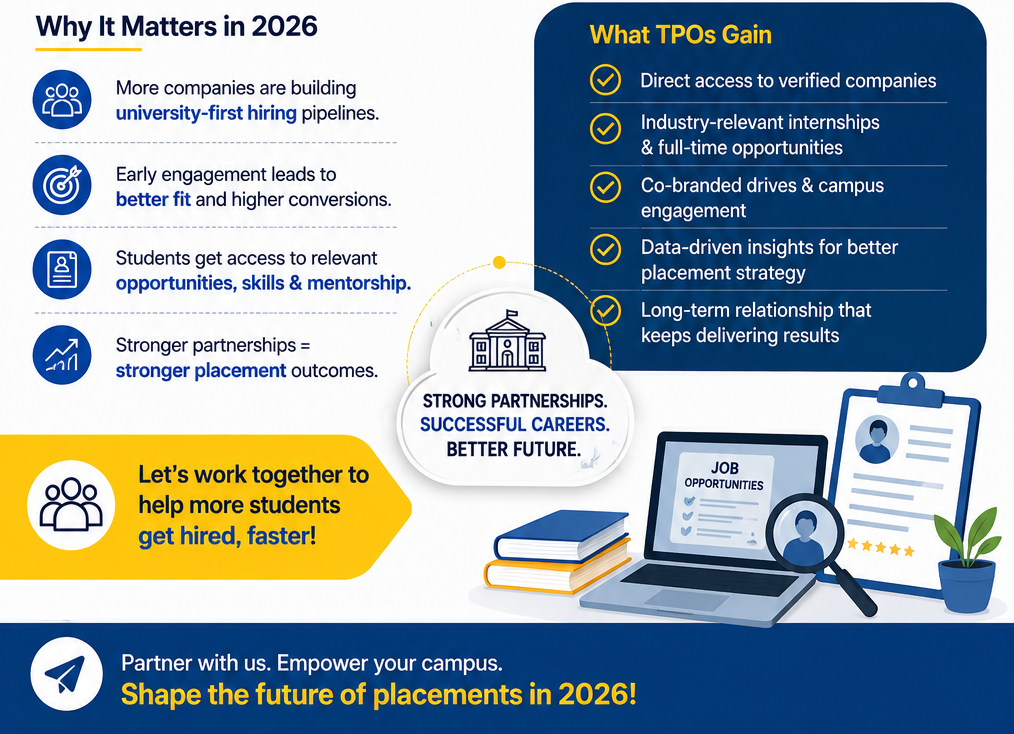
What Every Fresher Is Actually Up Against
Hundreds of resumes competing for one slot
Every opening posted during placement season pulls in far more applicants than a recruiter can properly review, and a strong candidate can get lost purely on volume.
No clear way to prove you're ready
Without a structured way to show your skills, marks or college name end up doing the talking instead of your actual ability.
Manual applying eats your time
Filling the same details into a new form for every listing, every drive, every company, leaves less time to actually prepare.
Opportunities capped by your college's own network
If your placement cell only has relationships with a handful of recruiters, your options are limited to whoever they've already invited — regardless of how ready you are.
What Structured Registration Actually Changes
Instead of filling a fresh form or emailing your resume for every single opening, you register once and your profile builds itself from that one resume — no retyping the same education and skills over and over for each application.
Why this removes the heaviest manual burden
One resume upload becomes a living profile that every employer browsing the platform can see — meaning your effort scales across every bulk hiring drive happening on the platform, not just the one you manually applied to.
What Skill Scoring and Wider Reach Actually Change
A structured AI interview gives you an actual score to point to — not a hope that your resume format gets noticed — for how ready you are on technical ability, communication, and problem-solving. And because employers discover you through that score rather than only through your college's own placement cell, you're visible to bulk hiring drives well beyond whatever recruiters happen to visit your specific campus.
The combined effect
Instead of every application depending on resume luck, and every opportunity capped by your college's local network, you get evaluated on demonstrated skill and discovered by companies actively hiring in bulk — including ones your placement cell may never bring to campus.
Your Placement Season Doesn't Have to Wait for a Scheduled Drive
Register once, complete a short AI interview, and get discovered by every bulk hiring company browsing the platform — not just the ones visiting your campus this term.
For freshers & final-year students. , and takes about two minutes to start.
Start Your AI InterviewApplying to Every Listing vs Registering Once
Applying job by job
Filling a new form, attaching your resume, and repeating the same details for every single job listing you find.
Registering once
Registering once with your resume, and letting your built profile stay visible to every employer browsing the platform afterward.
The honest verdict
Manually applying doesn't just take longer — the more openings you go after, the more repetitive and error-prone it gets. Registering once is one of the few parts of a job search that gets easier, not harder, the more opportunities you're chasing.
Hoping Your Resume Stands Out vs Getting an Actual Skill Score
Resume luck
Sending the same resume everywhere and hoping the right keyword or format catches a recruiter's eye in the few seconds they spend on it.
An actual skill score
Completing a structured AI interview and getting a specific score across technical skill, communication, and problem-solving that employers can actually review.
The honest verdict
A polished resume matters, but it can't show how you think or communicate under a real question — and that gap is exactly where strong candidates get missed.
Stop Hoping Your Resume Gets Noticed. Get a Score Instead.
A short AI interview gives employers something concrete to evaluate — not just a resume format.
See How Scoring Works
Your College's Recruiter List vs the Full Bulk Hiring Pool
Local recruiter list
Only the companies your placement cell has personally invited or built a relationship with — a fixed list, regardless of how many openings exist elsewhere.
The full bulk hiring pool
Every company browsing the platform's ranked candidate pool for bulk hiring, whether or not they've ever visited your specific campus.
The honest verdict
Your placement cell's relationships are genuinely valuable and worth using — this isn't a replacement, it's a second channel that isn't limited by how many recruiters your specific college has managed to invite.
One Application at a Time vs Getting Discovered Continuously
One application
An application you send once, which either gets a response or quietly disappears with no way to know what happened next.
Continuous discovery
A live profile that stays visible to every employer browsing the pool, continuously, long after you've stopped actively applying that day.
The honest verdict
A single application is a one-time bet. A registered profile keeps working for you in the background, even on days you're not actively applying to anything new.

A Simple Framework to Evaluate Any Hiring Platform Before Placement Season
Can I register once and stay visible, instead of reapplying for every opening?
Does it give me something more specific than a resume to prove I'm ready?
Does it expose me to employers beyond my own college's recruiter list?
Do I stay in control of who sees my contact details?
What to Actually Look For
One-time registration: build your profile from a single resume upload, not a new form for every listing.
Skill-based interview scoring: technical ability, communication and problem-solving assessed structurally, not guessed from a resume.
A wide, active employer pool: companies actively browsing ranked candidates for bulk hiring, not just a handful of names your college already knows.
Consent-based privacy: your contact details only shared with employers you personally approve.
prep tools built in: resume checking, cover letters, aptitude practice and mock interviews, without a separate cost.
Every Day Without a Profile Is a Day Employers Search Without You
Bulk hiring drives are browsing candidate pools right now, this placement season.
Register on RequireHire
Common Mistakes Freshers Make During Placement Season
Sending the exact same resume to every opening
A generic resume misses the specific keywords and framing that could get it past an initial screen for a particular role.
Treating one placement drive as the only shot
Waiting only for your college's scheduled visits ignores every bulk hiring drive happening outside that specific list.
Skipping aptitude and interview practice until the last minute
Readiness gaps are far easier to close with weeks of practice than in the panic of a scheduled interview slot.
Assuming your college's tier caps your opportunities
Skill-based screening evaluates your actual answers, not which campus you're sitting on.
The "More Applications = Better Odds" Myth
It's a natural instinct: if you're not hearing back, apply to more places. Surely more attempts means more chances.
What this misses
If every application is judged the same generic way — a resume skimmed for seconds — sending more of them doesn't fix the actual bottleneck. The real gap is usually earlier: nothing concrete proving your skill before a human even opens your resume. More applications without more visibility just means more silence, faster.
What Actually Changes When You Fix This
The shift, in plain terms
Before: hours spent retyping the same details into different forms, no real proof of your ability beyond a resume, opportunities limited to whichever companies your college happened to invite, and silence after most applications. After: one registered profile working across every bulk hiring drive on the platform, a specific skill score employers can actually review, visibility beyond your own college's network, and structured feedback even when a particular match doesn't work out. Job searching stops being a numbers game and starts being about being properly seen.
What Good Placement-Season Preparation Looks Like
A single, complete profile built from your resume, not scattered applications with different details everywhere.
An actual skill score from a structured interview, not just hope that your resume gets noticed.
Visibility to employers beyond your own college's recruiter list, extending what a single drive alone can offer.
tools already used to sharpen your resume and answers before it counts.
Your Starting Point, by Situation
Final-year student, placement season hasn't started
Register and build your profile early, so your skill score and readiness data are already in place before any drive begins.
Already in the middle of placement season
Start now — even mid-season, a registered profile puts you in front of every bulk hiring company actively browsing candidates today.
Fresh graduate applying independently
Skip resume roulette entirely; register once, take an AI interview, and let employers discover you instead of sending another cold application.
Studying at a Tier-2 or Tier-3 college
This matters most for you — skill scoring means your evaluation depends on your answers, not which recruiters happened to visit your specific campus.
Your Campus Placement Readiness Score
Check everything that's true for you right now, then calculate your score.
This Guide, in Numbers
Your Placement Season Deserves a Better Starting Point
Register once to see exactly how AI interview screening and skill scoring work for your profile.
Turning This Into a Plan: Before, During, After
Do: Register your profile weeks in advance
Building your profile and completing your first AI interview before drives begin means your skill score is already working for you when hiring season starts.
Don't: Wait until the week of your first drive
Registration and interview practice take real time to do properly — cramming it into the days before a drive limits how prepared you actually are.
Do: Use your skill score to prioritise where you invest energy
Focus your energy on opportunities and interview prep aligned with your strengths, guided by actual feedback instead of guesswork.
Don't: Let your profile go stale because you're busy interviewing
The busiest weeks of placement season are exactly when staying visible and responsive matters most.
Do: Keep your profile active even after you're placed or hired
Opportunities and better offers keep appearing; a dormant profile stops working for you the moment you stop checking it.
Don't: Delete or ignore your profile the moment one offer comes in
The first offer isn't always the best one — staying visible costs nothing and keeps your options open a little longer.
Your Final Checklist
You have one complete profile built from your resume, not scattered applications with different details everywhere.
You have an actual skill score from a structured interview, not just a resume you're hoping gets noticed.
You're visible to bulk hiring companies beyond your own college's recruiter list.
You know exactly how and when your contact details get shared with an employer.
This process is something you can keep running through the entire placement season, not a one-time attempt.
10 Questions Freshers Actually Ask About This

The Fresher Who Registers Today Gets Seen Before the One Still Emailing Resumes One at a Time
You now know exactly why capable freshers get missed during placement season, and how skill-based screening and wider employer reach fix it. The next step is simple: register once, and let this placement season find you instead of the other way around.
100% for job seekers, always.
Ready to Practice What You Learned?
Take a free AI mock interview and get your skill score in 15 minutes. 100% free for all candidates.
Related Posts
Practice Your Interview
Get ready for your next interview with our AI-powered mock interview tool.
Start Practice Interview