JavaScript and Its Importance in 2026
JavaScript and Its Importance in 2026
Every few years, someone predicts JavaScript is on its way out. The 2026 data says otherwise — and understanding exactly why matters more than the trivia itself, especially if you're deciding what to spend your next few months learning.

The short answer, before the long one
Yes — JavaScript is still central to the IT industry in 2026, arguably more than it was a few years ago. It remains the most-used programming language among developers worldwide, runs natively in every browser by default, has expanded deep into backend development through Node.js, and has become the primary language for shipping the AI-powered tools reshaping the industry, even when the underlying models are built in Python. The rest of this article breaks down why, with real numbers, and what it means for what you should actually be learning next.
The Confusion Is Real, and Reasonable
If you're trying to decide what to learn right now, the noise is genuinely disorienting. One article tells you Python is "taking over everything." Another says AI will write all the code within a few years, so none of it matters. A third insists JavaScript is "legacy" now that TypeScript exists. You're not imagining the contradictions — they come from real, valid data points being stripped of context and turned into headlines.
Here's the problem with picking a language based on hype alone: you can spend months learning the "right" one and still not get interview calls, because the language was never actually the bottleneck. This article is here to separate the real signal from the noise — using verifiable 2026 data, not predictions — so you can make a decision you don't have to second-guess three months from now.

What the Numbers Actually Show
use it client-side
it day to day
GitHub contributor base
2026 came from India
Sources: W3Techs (client-side usage, July 2026), Stack Overflow Developer Survey 2025 (developer usage), GitHub Octoverse 2025 (contributor growth, India developer share).
Start with the most basic fact: JavaScript is the only language that runs natively in every web browser without extra tooling. According to W3Techs, which tracks this continuously, JavaScript is used as the client-side programming language. That figure has barely moved in a decade, because there's no real competitor for that specific job.
Isn't Python winning everywhere now?
Python leads the TIOBE Index, which tracks search interest in language documentation, and it's genuinely dominant in AI, data, and automation work. But on the Stack Overflow 2025 Developer Survey, which asks developers what they actually use, JavaScript remains the most-used language overall, at roughly 66% of respondents — a position it has held for over a decade. These aren't contradictory numbers. TIOBE and Stack Overflow are measuring different things, and both are true at once: Python is growing fastest in one domain, while JavaScript continues to dominate a different, much larger one.
What about TypeScript overtaking it?
This is the detail most "JavaScript is dying" articles get wrong. TypeScript didn't replace JavaScript — TypeScript is JavaScript, with an added type-checking layer that compiles back down to it. GitHub's Octoverse 2025 report shows TypeScript overtaking Python in monthly contributor count for the first time in years, adding roughly a million new contributors in a single year. That's not a defeat for JavaScript; it's the JavaScript ecosystem maturing, as more teams adopt TypeScript for exactly the kind of large, AI-integrated applications being built right now.
Does the AI boom actually help or hurt JavaScript?
It helps, in a way that's easy to miss. Most AI models are trained and served using Python. But the products people actually use to interact with those models — chat interfaces, dashboards, coding assistants, browser extensions — are overwhelmingly built in JavaScript and TypeScript. One useful way to think about it: Python increasingly owns the model layer, while JavaScript and TypeScript own the layer between that model and the person using it. Both are growing because of AI, not despite it.
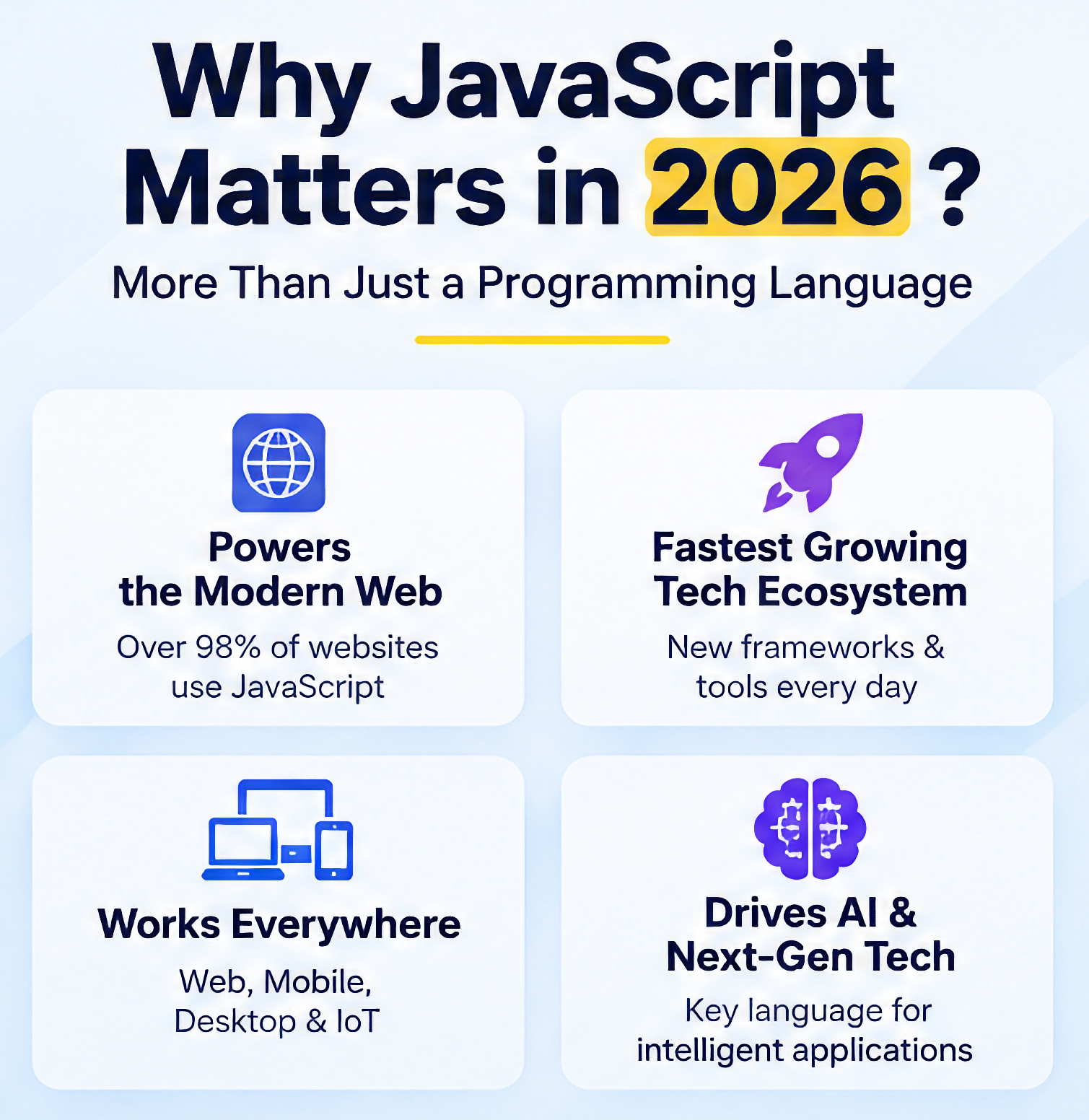
JavaScript Isn't Just "The Browser Language" Anymore
Our editorial assessment of where JavaScript's real hiring footprint is fine in 2026, based on current job-market and ecosystem data .
Why this matters for what you learn next
A decade ago, "learning JavaScript" mostly meant frontend work. In 2026, the same language, extended through Node.js and modern frameworks, can take you from frontend to backend to mobile without switching ecosystems. That range is a big part of why it stays relevant — it isn't standing still in one lane while other languages expand.
What This Looks Like in Real Indian Job Offers
Fresher, Entry-Level
₹3–5 LPA
Typical starting range for JavaScript and web development roles, based on aggregated public salary data. Strong projects and internship experience push offers toward the higher end.
City Differences
+25–27%
Roughly how much more Hyderabad, Bangalore, and Pune pay compared to many other cities for the same role — though remote hiring is steadily narrowing this gap.
With Experience
₹6.5–12.8L
Reported range for developers around the two-year mark, particularly at product and SaaS companies building on React, Node.js, and TypeScript stacks.
Indicative ranges aggregated from public salary data as of 2026. Actual offers vary by company, skill depth, and negotiation.
Company type shapes this as much as city does. Service companies tend to hire in bulk at lower starting packages, often for maintenance-heavy or testing-adjacent JavaScript work. Product companies and startups — especially in fintech, SaaS, and AI-adjacent products — pay meaningfully more, but expect a stronger technical bar even at entry level: real projects, some backend exposure, and comfort with at least one modern framework, not just static HTML and CSS.
For a deeper look at how this compares across a wider set of languages, our roundup of top programming languages for 2026 IT jobs breaks it down further, and our web development skills and scope guide goes deeper on the frontend side specifically.

Which JavaScript Career Path Fits You
"Learn JavaScript" isn't one job description. Here's what the same language actually looks like in four different roles.
Frontend Developer
You build what people click, tap, and scroll through — layouts, interactions, and everything visible in the browser.
Core stack: JavaScript, React or Vue, HTML/CSS
Best fit if: you like instant visual feedback
Backend / Node Developer
You build the APIs, databases, and logic running behind the scenes that the frontend actually talks to.
Core stack: Node.js, Express, SQL/NoSQL databases
Best fit if: you like systems and data flow over pixels
Full-Stack Developer
You move between frontend and backend on the same project, often within a single framework like Next.js.
Core stack: React/Vue + Node.js + a database
Best fit if: you want maximum flexibility
Mobile Developer
You build iOS and Android apps from a single JavaScript codebase instead of two separate native ones.
Core stack: React Native, native modules
Best fit if: you want mobile without Swift/Kotlin
You don't have to pick a lane on day one
Most learners get the fastest feedback loop — and the easiest first portfolio pieces — by starting frontend, then branching into Node.js once the fundamentals are solid. Because it's the same core language throughout, that move doesn't mean starting over.

5 Projects That Actually Prove You Know JavaScript
Recruiters don't score how many courses you finished. They look at what you shipped — in roughly this order of difficulty.
Personal portfolio site with a working contact form
Proves you can handle layout, deployment, and basic form logic end to end.
Mistake to avoid: shipping it with placeholder text and dead links — recruiters do click through.
To-do or habit tracker with real data persistence
Proves you understand state management and basic create-read-update-delete logic.
Mistake to avoid: hardcoding sample data instead of actually saving and reloading it.
Weather or public-API dashboard
Proves you can handle asynchronous calls, loading states, and errors from a live API.
Mistake to avoid: no loading or error state, so the app visibly breaks the moment the API is slow.
Full-stack app with real authentication
Proves Node.js/Express, a database, and a working login flow — the combination most product companies actually hire for.
Mistake to avoid: storing passwords in plain text — an instant red flag in a technical review.
One deployed project that solves a problem you actually have
Proves initiative and product thinking — the thing tutorials structurally can't teach you.
Mistake to avoid: never actually deploying it, so it stays code only you have seen.
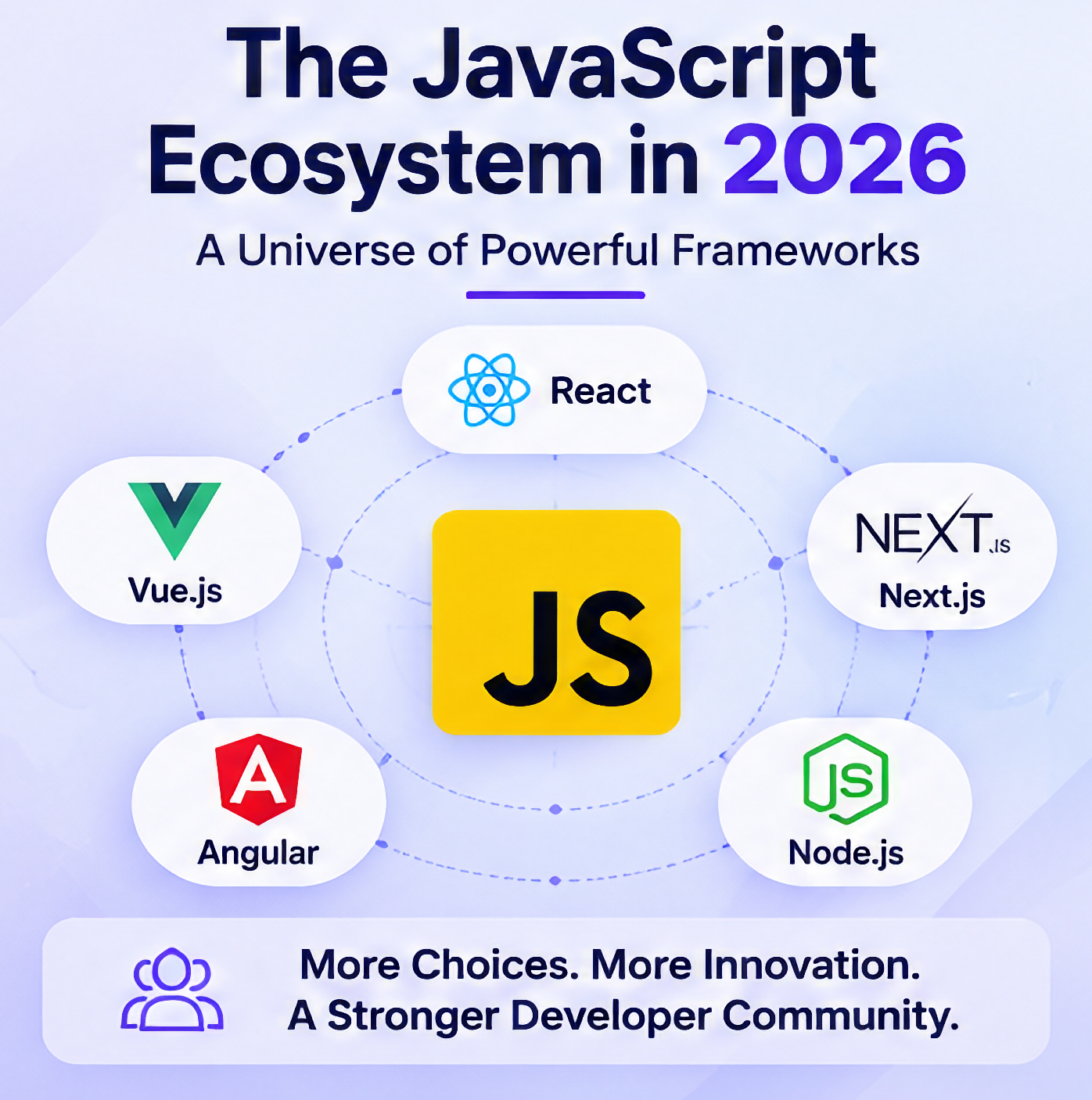
Common Mistakes That Get JavaScript Developers Rejected
Learning frameworks before fundamentals
The mistake: jumping straight into React tutorials without understanding how JavaScript itself handles functions, scope, and asynchronous code. The fix: spend real time on vanilla JavaScript first — most interview rejections trace back to shaky fundamentals, not unfamiliarity with a specific framework.
Tutorial-hopping without building anything original
The mistake: finishing course after course but never writing a project starting from a blank file. The fix: after every tutorial, rebuild a version of it from memory with one meaningful change — that's the point where the concepts actually stick.
Treating async/await and promises as optional
The mistake: avoiding anything involving APIs or async code because it feels confusing. The fix: this is one of the most commonly tested topics in JavaScript interviews precisely because so many candidates avoid it — practice it deliberately instead of working around it.
No real version-control habit
The mistake: writing code without git, or using it only to store files rather than track history. The fix: commit in small, meaningful chunks on every project — interviewers do look at commit history, not just the final code.
Freezing when asked to explain your own code
The mistake: being able to write code silently but not narrate your reasoning out loud under mild pressure. The fix: practice explaining a project you built, live, to another person or an AI mock interviewer — it's a distinct skill from writing the code, and often the actual deciding factor in interviews.

Your Practical 90-Day Roadmap
Turning "should I learn this" into exactly what to do this week.
Days 1–30 — Fundamentals, done properly
~1.5–2 hrs/day
- Variables, functions, arrays/objects, loops, conditionals
- DOM manipulation basics, no framework yet
- Ship one small vanilla-JS project (calculator, quiz app)
Days 31–60 — One framework, one real project
~2 hrs/day
- Pick React (or Vue) and go deep on one, not both
- Learn to call and handle a public API properly
- Build and deploy the API-dashboard style project
Days 61–90 — Backend, deployment, interview practice
~2 hrs/day + mock interviews
- Basic Node.js + Express connected to a simple database
- Build the full-stack project with authentication
- Practice explaining your projects out loud, repeatedly
This is a floor, not a ceiling
The exact day count will compress or stretch depending on your prior experience and daily practice time. What matters more than the calendar is the sequence — fundamentals, then one framework, then backend plus real interview practice — in that order.
How JavaScript-Ready Are You, Honestly?
Four quick questions. About 45 seconds.
What You're Probably Still Wondering
Tap each card for the direct answer.
"Isn't Python taking over everything?"
Tap for the honest answer →
Python is genuinely dominant in AI, data, and automation work. But it has almost no presence in the browser, where JavaScript remains essentially unchallenged. They're mostly not competing for the same roles — see our full breakdown of whether Python will actually replace other languages for the complete picture.
"Will AI tools make this skill less valuable?"
Tap for the honest answer →
AI coding assistants write code faster, but someone still has to know if that code is correct, debug it, and defend the architecture in an interview. And a large share of the AI tools themselves are built with JavaScript and TypeScript, so the skill is part of what makes you useful on that side of the industry too.
"Is JavaScript enough on its own to get hired?"
Tap for the honest answer →
Knowing the language is the starting line, not the finish. What actually gets interview calls is a handful of real, deployed projects and the ability to explain your decisions out loud — the language on your resume rarely differentiates you by itself anymore.
Myths vs Facts: What's Actually True in 2026
Myth
JavaScript is only for beginners — serious engineers move to other languages.
Fact
JavaScript and TypeScript are used at every major tech company, including for large-scale backend and infrastructure work, not just simple frontend scripts.
Myth
AI will replace JavaScript developers within a couple of years.
Fact
AI tools change how code gets written, not whether someone needs to understand, review, and be accountable for it — and the tools themselves are largely built in JavaScript and TypeScript.
Myth
You need a computer science degree to get hired.
Fact
Many product companies and startups hire primarily on deployed projects and practical interview performance, especially for frontend and full-stack roles.
Myth
Once you know JavaScript, frameworks are basically interchangeable — just pick any one.
Fact
Frameworks share core JavaScript concepts, but each has real differences in ecosystem size, hiring demand, and learning curve — the choice still matters practically.
Myth
TypeScript is a separate skill you can put off indefinitely.
Fact
TypeScript compiles down to JavaScript and is now the default expectation at most mid-size and large product companies in 2026.
Curious how you'd actually score in a real interview?
Not a syntax quiz — a live, AI-run mock interview that gives you a skill score in about 15 minutes.
Find Out in 15 MinutesOnce You've Got the Skills, Prove Them
We provide the same top-tier version of every tool to everybody who joins — there's no held-back experience waiting behind a better one.
Top-Tier AI Mock Interviews
Practice explaining your own JavaScript projects out loud to an AI interviewer, then get a skill score you can actually act on.
Start a mock interview →Aptitude Practice, Same for Everyone
Practice sets covering the logical reasoning patterns common across entry-level technical hiring, at the same top-tier standard for every candidate.
Try the aptitude tests →Real Job Matching
See which companies are actually hiring for JavaScript, React, and Node.js roles right now, filtered by your city and experience level.
Search open roles →What Recruiters Actually Screen For
Keywords get your resume past the first filter. These are the things that actually move a real hiring decision.
A live link, not just a repo
Recruiters often skip repos with no working deployed link. Host projects free on Vercel, Netlify, or Render, and put that live link on your resume, not just the GitHub URL.
Commit history that shows real work over time
A single giant "final commit" reads very differently from a visible, incremental build process. Commit in small, honest chunks as you actually build.
A README that explains the "why," not just the "what"
What problem the project solves, and what you'd improve given more time, signals product thinking — not just the ability to follow a spec.
Ability to explain trade-offs, not recite syntax
Real interviews increasingly probe why you chose an approach, not whether you memorized syntax. Practice narrating decisions, not definitions.
Consistency between resume claims and live performance
Listing "React, Node.js, MongoDB" and then freezing on a basic question about any of them is one of the fastest ways to lose credibility mid-interview. Only list what you can defend live, under mild pressure, without notes.
Quick Answers to What People Actually Ask
Is JavaScript still worth learning in 2026?
Yes. It remains the most-used language among developers worldwide and runs client-side on 98.9% of all websites, per W3Techs. It has also expanded well beyond the browser into backend development and AI-product interfaces.
Should I learn JavaScript or Python first?
They serve different purposes more than they compete. Python leads in AI, data, and automation; JavaScript remains essential for anything a user directly interacts with, and increasingly for backend services too. Many developers end up learning both.
Does AI reduce the need to learn JavaScript?
Not in practice. AI tools speed up writing code, but someone still needs to understand, debug, and architect it — and a large share of the tools used to ship AI products are themselves written in JavaScript and TypeScript.
What can I actually build with JavaScript beyond websites?
Backend APIs through Node.js, mobile apps through React Native, desktop applications through Electron, browser automation and tooling, and the interfaces used to deliver AI-powered products to end users.
How long does it take to become job-ready in JavaScript?
Most self-taught learners need three to four months of focused, daily practice — covering fundamentals, one framework, and two to three deployed projects — before they're ready to apply for junior roles. Consistent practice matters more than raw hours.
Is JavaScript harder to learn than Python?
Not fundamentally. Python's syntax is slightly more forgiving at the very start, but JavaScript's core concepts are comparably simple. Its reputation for difficulty usually comes later, from asynchronous code and the browser DOM.
Do I need to learn TypeScript separately from JavaScript?
Plain JavaScript gets you hired at many companies, but TypeScript is the default expectation at most product and mid-to-large companies by 2026. Learn JavaScript fundamentals first — TypeScript typically takes only a few extra weeks after that.
Should I learn React, Vue, or Angular first?
React first, mainly for its larger hiring footprint and learning resources. Vue has a gentler curve; Angular shows up more in enterprise and service-company codebases. Learning React first makes the others faster to pick up later.
Can I get a JavaScript developer job in India without a computer science degree?
Yes, particularly at startups and product companies that screen mainly on deployed projects and live coding ability. It's harder at large service companies with degree-first campus pipelines, so a stronger portfolio matters more if you're self-taught.
What is the average JavaScript developer salary in India in 2026?
Entry-level roles typically start around ₹3–6 LPA, rising to roughly ₹6.5–15.8 LPA by the two-year mark at product and SaaS companies using React, Node.js, and TypeScript. Location and backend depth both move this range.
Skills Matter More Than the Debate Around Them
Whichever language you're building with, what actually gets you hired is proof — real projects and real interview practice. Every jobseeker on RequireHire gets the same top-tier version of our tools, from day one.
Ready to Practice What You Learned?
Take a free AI mock interview and get your skill score in 15 minutes. 100% free for all candidates.
Related Posts
Practice Your Interview
Get ready for your next interview with our AI-powered mock interview tool.
Start Practice Interview